Today I stumbled upon a quote by Lawvere:
There has been for a long time the persistent myth that objects in a category are “opaque”, that there are only “indirect” ways of “getting inside” them, that for example the objects of a category of sets are “sets without elements”, and so on. The myth seems to be associated with an inherited belief that the only “direct” way to deal with whole/part relations is to write an unexplained epsilon or horseshoe symbol between A and B and to say that A is then “inside” B, even though in any model of such a discourse A and B are distinct elements on an equal footing. In fact, the theory of categories is the most advanced and refined instrument for getting inside objects, because it does provide explanations (existence of factorizations of inclusion maps) and also makes the sort of distinctions that Volterra and others had noted were necessary for the elements of a space (because the elements are morphisms whose domains are various figure-types that are also objects of the category)
F. W. Lawvere, Functorial Semantics of Algebraic Theories and Some Algebraic Problems in the context of Functorial Semantics of Algebraic Theories
Lawvere wrote this 20ish years ago and yet this myth is still not dead! The simplicity and superiority of generalized elements (and, more broadly, of internal logic) seems to be left aside way too often, especially when teaching category theory: it's such an easy win to leverage set-theoretic intuition to nurture a structuralistic one!
However, like all good things in life, the element-free/generalized elements dialectic is much more interesting than either of the two sides it insists on.
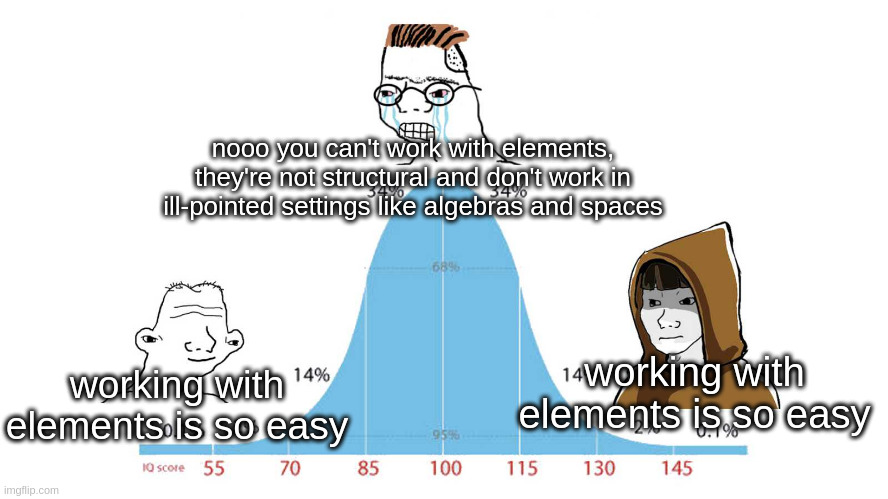
The first rebuttal to Lawvere, in fact, is that element-freeness is not a 'myth' tout court, since it is true that category theorists strive to avoid working with elements directly, at least as a widespread stylistic choice.
But there's more to it.
As I remarked in one of my last posts, objects of a category are mere labels which are substantiated by morphisms. In particular, it's not at all given that if you label your objects with concrete stuff, their set-theoretic elements (call these fool's elements) coincide with their 'actual', i.e. category-theoretic generalized elements.
That's the true meaning of the categorical wisdom of element-freeness: don't fool yourself, use the right elements. Indeed, the point is precisely than using morphisms to pick out elements is the way to go, as witnessed by the fact it works in all settings uniformly, unlike materialistic notions of elementhood.
To sum up: category theorists don't work with elements, they work with 'generalized elements' (i.e. morphisms) which are the right notion of elementhood in a structuralist setting. The old adage of working element-free is a cautionary tale for all those settings in which one could fall for a notion of elementhood which is not the right one, but the one falsely suggested by a set-theoretic labeling on objects.
Category theory doesn't reject the notion of elementhood, but instead fully realizes it.