This is a more of less up-to-date list of the topics I'm working on. For a list of talks, preprints and papers, check out this page. For dormant research topics, see here.
I'm open to collaborations in any of the topics listed below, you can get in touch.
research topic1Double Operadic Theory of Systems
- February 14, 2026
- Matteo Capucci
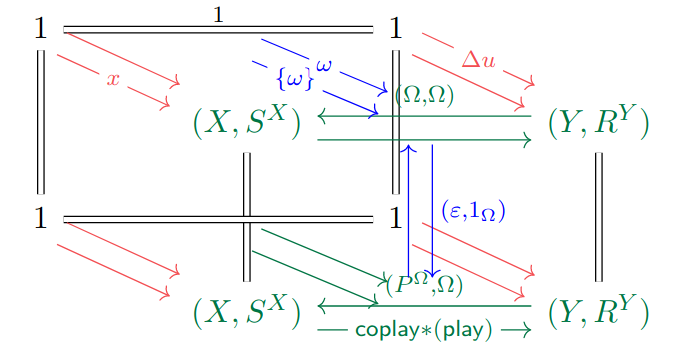
Double Operadic Theory of Systems (DOTS), neé (Doubly) Categorical Systems Theory ((D)CST), is a formal mathematical theory of systems. A theory of systems is the algebra of a double operad: the operations of the operad describe how to compose systems, while the algebra substantiates these operations into actual functors between categories of systems. This structure combines both the compositional and structural aspects of systems theory, with the operad part describing compositionality and the categorical part describing the structure of systems.
DOTS being formal means we can work at a level of generality at which we can meanigfully talk about the subjects of systems theory—systems, processes, interfaces, behaviours, etc.—without ever having to commit to a specific way to model them (coalgebras, machines, decorated cospans, behaviour types, etc.).
I'm working on DOTS within the ARIA project 'Safeguarded AI' in close collaboration with Topos Research UK and the folks there (David Jaz Myers, Sophie Libkind, Jason Brown, José Siqueira, etc.)
Reading list
- Dynamical systems and sheaves, by David Spivak, Patrick Schultz, and Christina Vasilakopoulou
- Open Systems: A Double Categorical Perspective, by Kenny Courser
- Categorical Systems Theory, by David Jaz Myers
- Notes on Categorical Systems Theory, by me
- Towards a double operadic theory of systems, by David Jaz Myers and Sophie Libkind
- Representable Behaviour in Double Categorical Systems Theory, by me
- The most up to date account of DOTS is this lecture series by David Jaz Myers
research topic2Quantitative Logic
- February 14, 2026
- Matteo Capucci
Most attributes of systems aren't qualitative absolutes, but quantitative statements. How far things are from each other, how much error there is in an approximation, what is the probability of a property being satisfied, and so on. Thus adapting the structural methods of logic, category theory, and categorical systems theory to a quantitative setting is crucial for making them practically useful.
Meanwhile, many ideas and phenomena in statistics, machine learning, and functional analysis have a logical flavour. Can we turn this hunch into a tool to understand such settings in a new light?
Together with Bob Atkey and Ekaterina Komendantskaya I am developing quantitative logic in the sense of F. William Lawvere, i.e. as an 'enriched' logic. We started from a propositional theory, which we dubbed quantitative linear logic (QLL), and we are now moving on to predicate logic.
We put a strong emphasis on softness, thus relaxing the hard properties of lattice connectives (\(\lor , \land \)) to accomodate more useful quantitative connectives (like \(+\) and \(\times \)).
Thomas Flinkow also helped us investigating the role quantitative logic can have in property-driven learning, with very encouraging results.
Reading list
- On Quantifiers for Quantitative Reasoning, by me
- Adequate Losses via Quantitative Linear Logic, by me, Bob Atkey, Ekaterina Komendantskaya, and Charles Grellois
- Quantitative Linear Logic for Neuro-Symbolic Learning and Verification
- A Taste of Quantitative Logic (Part 1 (slides, video) and Part 2 (slides, video)), by me
research topic3Structural primitives for cybernetics
- February 14, 2026
- Matteo Capucci
Cybernetic systems self-adapt through the observations they make of the 'environment' which interacts with them. In games, this dynamics brings players to play equilibria. In machine learning, it makes models learn from a dataset and RL agent adapt to an environment. In control theory, it keeps systems in a viable state.
Category theory can put the mathematical treatment of these systems on strong and flexible foundations. We can then use string diagrams to describe systems compositionally, categorical logic to impose guarantees on their behaviour, and functional programming to produce efficient and effable programs to analyse them.
My main research focus is develop structural primitives for cybernetics, working in the groove of categorical systems theory. A concrete goal is characterizing good regulators abstractly, and develop a modern, model-free internal model principle.
Reading list
- The series of posts on open cybernetics on this blog
- Towards Foundations of Categorical Cybernetics by me, Bruno Gavranovic, Jules Hedges, Eigil Fjeldgren Rischel
- From categorical systems theory to categorical cybernetics, by me
- Mathematical Foundations for a Compositional Account of the Bayesian Brain, by Toby St Clere Smithe
- A Bayesian Interpretation of the Internal Model Principle, by Manuel Baltieri, Martin Biehl, Nathaniel Virgo, and me