Some topics which I worked on, but I'm currently not actively pursuing.
research topic1Categorical game theory
- February 14, 2026
- Matteo Capucci
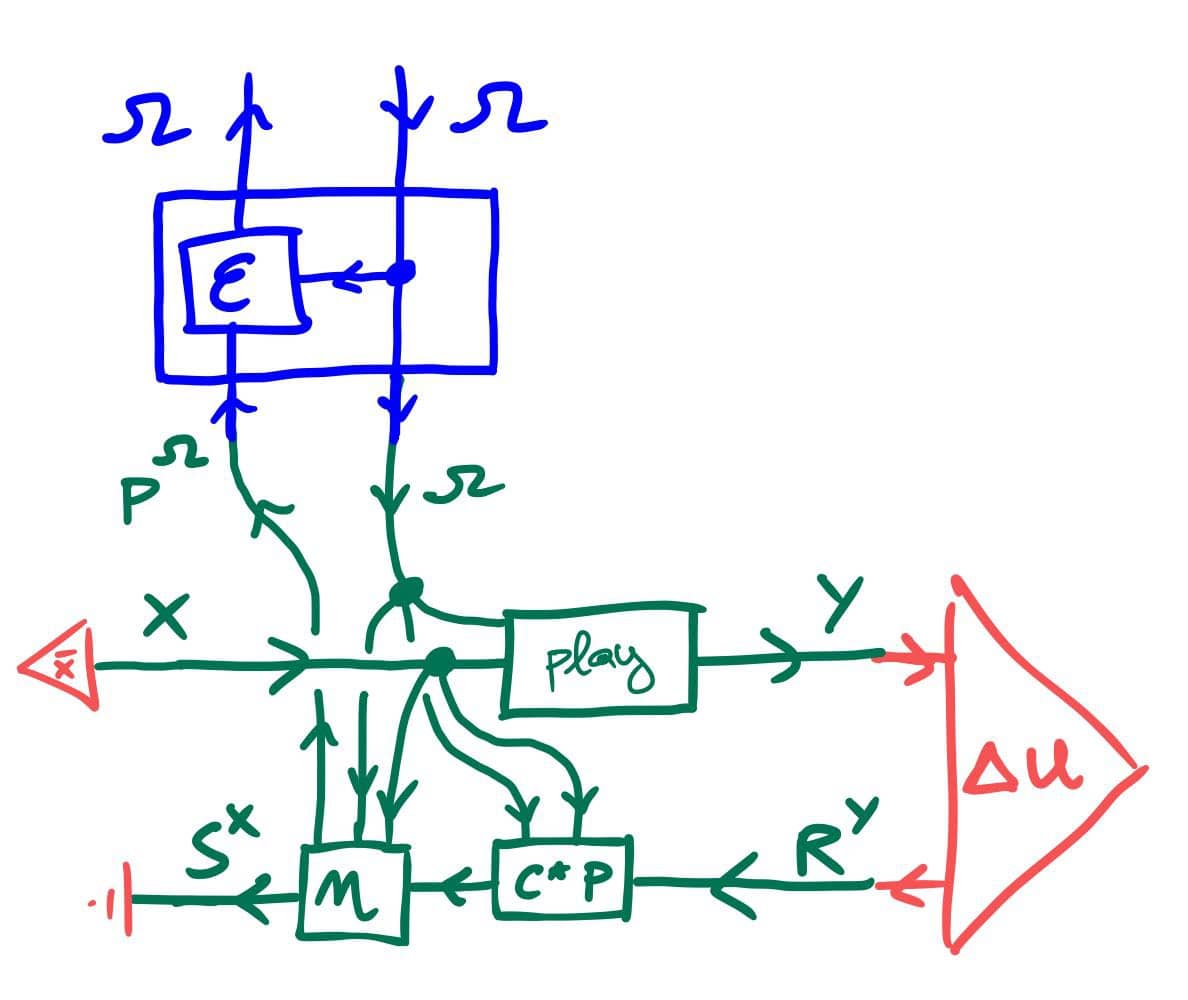
Game theory is a fascinating subject studying the behaviour of self-interested interacting agents. All cybernetic systems feature agents trying to control a given system with a goal in mind, but games are unique in their compositional structure.
In fact the composition of many game-theoretic agents looks different from any of the composee. This is a consequence of the information flow of a game, which starves player of crucial information on the consequences of their action. The main issue with this state of affairs is that the more players are together the harder it is for them to reach mutually beneficial states (Pareto optima).
Category theory can describe this very well, by bringing to the table a few crucial ingredients:
- Good 'forms' to model the dynamics of a game; less unwieldly than extensive forms but also more expressive than normal form,
- Off-the-shelf compositionality, both for specifying games and for computing their behaviours (e.g. Nash equilibria),
- Conceptual discernment, for instance clarifying the relation between learning and games, or why games have such a peculiar phenomenology.
Categorical game theory has been brewing for a while, and now foundations are almost done. The first goal is to reproduce classical results and tools from game theory, reframing them in a more scalable and conceptually convincing mathematical framework. Then we can start to go beyond that: my current goal is to understand compositionality of agency, see here.
Reading list
- Compositional game theory, by Neil Ghani, Jules Hedges, Viktor Winschel and Philipp Zhan
- Open cybernetic systems II: parametrised optics and agency, by me
- Diegetic representation of feedback in open games, by me
research topic2Emergence and higher-order effects in compositionality
- February 14, 2026
- Matteo Capucci
Emerging properties of a systems are those properties we can't ascribe to any of the parts composing it, but instead arise from the way we compose them. In general systems theory, this usually manifests as a failure of naive compositionality of behaviour: to compute the behaviour of a system it is not enough to naively collate the behaviour of its parts. Instead, the pattern used to compose the system has to be taken into account to arrive at the true behaviour of the whole.
Using the framework of categorical systems theory we can characterize emergence very precisely as the failure of a certain lax naturality constraint to be invertible. The quest is thus to (1) develop tools to study these failure, inspired by cohomology theory and (2) develop tools to amend naive compositionality to take emergence into account.
Reading list
- Systems, Generativity and Interactional Effects by Elie Adam,
- Lax functors describe emergent effects by Jules Hedges,
- Fantastic sheaves and where to find them by myself,
- Structured Decompositions: Structural and Algorithmic Compositionality, by Benjamin Merlin Bumpus, Zoltan A. Kocsis, Jade Edenstar Master
research topic3Dependent optics
- February 14, 2026
- Matteo Capucci
Bidirectional transformations are ubiquitous in applied category theory, in the form of lenses, Dialectica categories, morphisms of containers, modular data accessors, and more. In particular, they provide the foundations for categorical cybernetics.
This is a somewhat technical topic. The current goal in dependent optics is to find good dependently-typed generalizations of optics, which are themselves a generalization of lenses. Optics seems to have better operational properties than lenses, and capture a wider range of bidirectional transformations.
Reading list
research topic4Relativization of stochastic calculus
- February 14, 2026
- Matteo Capucci
Some theories are unnaturally complicated when described in the language of sets. Using the languages of other topoi can help to make them look simpler, and therefore to be simpler to work with. In a sense, relativization is the search for the natural habitat of a mathematical theory, where it can be ‘its true self’ and thrive. Stochastic calculus is one such a theory: topoi of sheaves over suitably defined sites make the theory tame and natural-looking.
My goal was to construct Ito's and Stratonovich's integrals in this way.