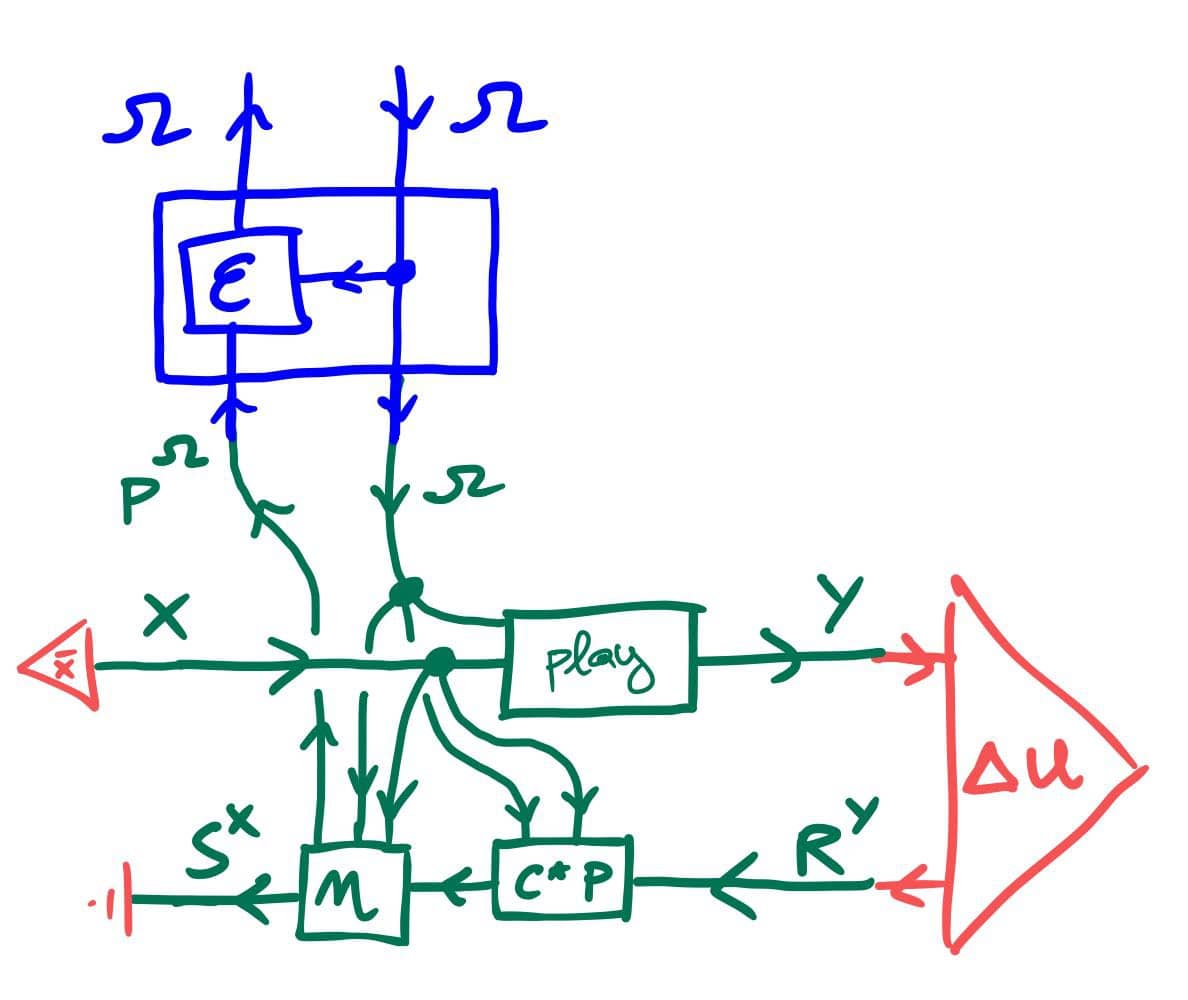
Game theory is a fascinating subject studying the behaviour of self-interested interacting agents. All cybernetic systems feature agents trying to control a given system with a goal in mind, but games are unique in their compositional structure.
In fact the composition of many game-theoretic agents looks different from any of the composee. This is a consequence of the information flow of a game, which starves player of crucial information on the consequences of their action. The main issue with this state of affairs is that the more players are together the harder it is for them to reach mutually beneficial states (Pareto optima).
Category theory can describe this very well, by bringing to the table a few crucial ingredients:
- Good 'forms' to model the dynamics of a game; less unwieldly than extensive forms but also more expressive than normal form,
- Off-the-shelf compositionality, both for specifying games and for computing their behaviours (e.g. Nash equilibria),
- Conceptual discernment, for instance clarifying the relation between learning and games, or why games have such a peculiar phenomenology.
Categorical game theory has been brewing for a while, and now foundations are almost done. The first goal is to reproduce classical results and tools from game theory, reframing them in a more scalable and conceptually convincing mathematical framework. Then we can start to go beyond that: my current goal is to understand compositionality of agency, see here.
Reading list
- Compositional game theory, by Neil Ghani, Jules Hedges, Viktor Winschel and Philipp Zhan
- Open cybernetic systems II: parametrised optics and agency, by me
- Diegetic representation of feedback in open games, by me